
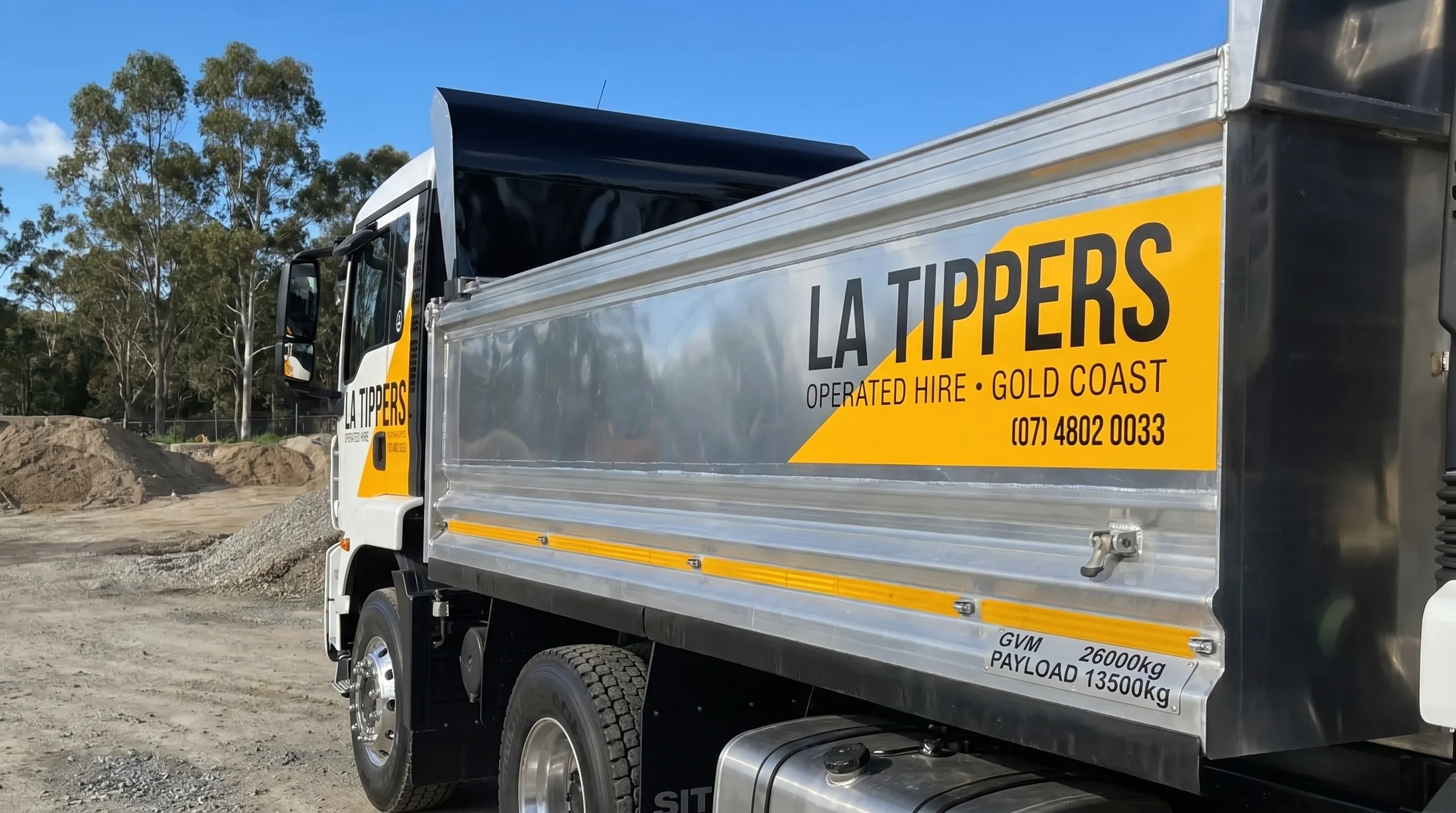
A tipper truck sizing guide for Gold Coast civil sites — written so you can pick the right truck the first time without overspending on capacity you don't need or undersizing for the job and paying for an extra cycle.
The decision usually comes down to four things: payload (how much weight), volume (how much it physically holds), access (can it physically get into your site), and number of cycles (how many trips back to the tip or supplier).
Tipper truck sizes in Australia — the real categories
Three main configurations on Australian roads for civil-scale work:
- Mini tippers / 3-tonne (Iveco Daily, Hino 300 series). Small, suburban access, ~3-tonne payload, ~3m³ bed. Useful for residential landscaping, small DIY drops. Not for civil-scale work.
- Mid-size 6-wheelers (6×4) (SITRAK, Isuzu FYJ, Hino 700 series). 7.5–8m long, ~10m³ bed, ~15-tonne payload. Sweet spot for most Gold Coast civil and commercial work — fits subdivision and constrained-access sites a bigger truck can't.
- 8-wheelers (8×4). ~9.8m long, ~12m³ bed, payload up to 32 tonnes. More capacity per trip but harder to fit on narrower access sites. Common for quarry haul and big civil bulk work.
- Truck and dog combinations. The most popular Australian configuration for big haul. Up to 40+ tonnes per trip. Doesn't fit most Gold Coast subdivision sites — too long.
Payload vs volume — the critical distinction
Tipper trucks have two limits: how much they can physically hold (volume, in m³) and how much weight they can legally carry (payload, in tonnes). The smaller of the two binds.
For light material like dry sand or topsoil, you usually max out on volume before weight. A 10m³ bed of dry topsoil weighs about 12–14 tonnes — well under our 15-tonne payload limit.
For dense material like crushed rock or wet sand, you max out on weight first. A 10m³ bed of wet sand weighs 18–20 tonnes — over our payload limit. We'd carry less than a full bed to stay legal.
Rule of thumb: for fill, spoil, dry sand and lighter materials, optimise for volume (number of m³ moved). For wet sand, road base, crushed rock and demolition rubble, optimise for weight (number of tonnes moved).
Overload fines — why we don't push the payload
Overloading a heavy vehicle in QLD attracts fines from $5,000 per breach plus 6 demerit points on the operator's licence. NHVR enforcement uses weighbridges and roadside checks. Repeat breaches can cost the operator their accreditation and the customer their site insurance position.
Practically: we won't overload to save you a cycle. If the spoil density turns out denser than expected, we'll do an extra load instead. The maths works out cheaper than the fine and incomparably cheaper than losing the truck off the road.
How to estimate cycles for your job
Quick formula for a fill/spoil removal job:
- Total volume to move (m³) ÷ truck bed capacity (m³ per load) = number of loads
- Round up — you can't do a half-cycle
- Each cycle is roughly 60–90 minutes including loading, travel, and tipping (depending on tip distance)
Worked example: 30m³ of clean fill from a Burleigh subdivision lot to a soil-recovery yard 15 minutes away. 30 ÷ 10 = 3 loads. ~75 min per cycle = ~3.75 hours. Round up to 4-hour minimum. Total job: about 4 hours of operator time.
Access constraints — the silent budget killer
On Gold Coast civil sites, access is more often the binding constraint than payload. Here's where each truck size starts to fail:
- Older Mermaid Beach / Burleigh / Palm Beach streets: kerbside parking, narrow turning circles, low-hanging trees. 8-wheelers and truck-and-dog combos struggle. Mid-size 6×4 fits.
- Subdivision lots mid-build: often only one access route, sometimes shared with other trades. Bigger trucks block site flow.
- Robina, Varsity Lakes, Mudgeeraba newer subdivisions: wider access generally, both 6-wheeler and 8-wheeler work.
- Coomera and Upper Coomera larger civil precincts: any size works. Truck-and-dog optimal for the bigger pours.
If you're not sure about access at a specific site, just ask — we'll do a quick drive-by before quoting if needed.
The decision tree we'd use
For a Gold Coast civil contractor estimating a job, the sizing logic looks roughly like this:
- Volume to move < 10m³? Mid-size 6-wheeler, single load.
- Volume 10–30m³? Mid-size 6-wheeler, 1–3 cycles. Most common Gold Coast civil scenario.
- Volume 30–100m³, access OK? 8-wheeler if available, otherwise 6-wheeler with more cycles.
- Volume 100m³+ on a major civil site with full access? Truck-and-dog combo from a quarry-haul operator. Different operator class than us.
- Tight Gold Coast suburban access regardless of volume? Mid-size 6-wheeler — the access wins.
Why we run the SITRAK G5S 6×4
Our truck is a SITRAK G5S 6×4 — 310 HP, Euro 6 emissions, ~10m³ bed, ~15-tonne payload, Allison 3200P 6-speed automatic. Mid-size by Australian civil standards. We picked it because:
- Fits 90%+ of Gold Coast civil sites — including the older suburb access where 8-wheelers can't go
- Big enough to clear most subdivision spoil in 2–3 loads (rarely needs 5+)
- Euro 6 emissions standard — useful for sites with environmental compliance requirements
- Allison automatic — lower operator fatigue on the long days, fewer mechanical issues
How to decide for your specific job
Three numbers tell us what truck class your job needs:
- Estimated volume to move (or volume to deliver) in m³
- Estimated material density — light (fill, dry sand, topsoil), medium (gravel, road base), heavy (wet sand, crushed rock, demolition concrete)
- Site access constraints — full subdivision lot vs older suburb street vs constrained inner-city access
Send those to us with the rough dates and we'll come back same day with the right truck recommendation, hours estimate, and firm quote.